

Better aviation leads don’t come from a bigger budget. They come from knowing exactly who you’re talking to, saying it in language they recognize, and following the ones already on approach.
Table of Contents
What “Quality Aviation Leads” Actually Means
In flying, you don’t measure a good flight by hours logged. You measure it by whether the airplane, crew, and passengers arrived safely, smoothly, and with purpose.
Marketing works the same way.
Quality aviation leads are the ones already in your airspace: the right mission, budget, authority, and urgency. The ones likely to land, not just shoot endless low approaches.
And here’s the part most operators miss. You don’t need a bigger budget to attract better leads. You need to tighten up who you target, what you say, and how you follow the aircraft you’re already tracking.
If you’re newer to marketing fundamentals, start with our pilot’s guide to aviation marketing basics and come back here. Otherwise, let’s take off.
Why Most Aviation Businesses Chase The Wrong Aviation Leads
Think of the typical aviation marketing approach as a VFR pilot who never checks NOTAMs: lots of activity, very little intention.
Most flight schools, charter operators, maintenance shops, and avionics shops do this:
- Blast the same ad to everyone
- Send generic emails that could apply to any pilot
- Write copy that reads like corporate turbulence
- Retarget everyone identically, or not at all
That’s like teaching every student the same crosswind technique regardless of aircraft, weight, or runway.
The fix is three levers: segmentation, refined ad copy, and behavior-based retargeting. None of them costs more money. All of them change what you get for the money you’re already spending.
1. Segment Your Audience Like You Segment Airspace
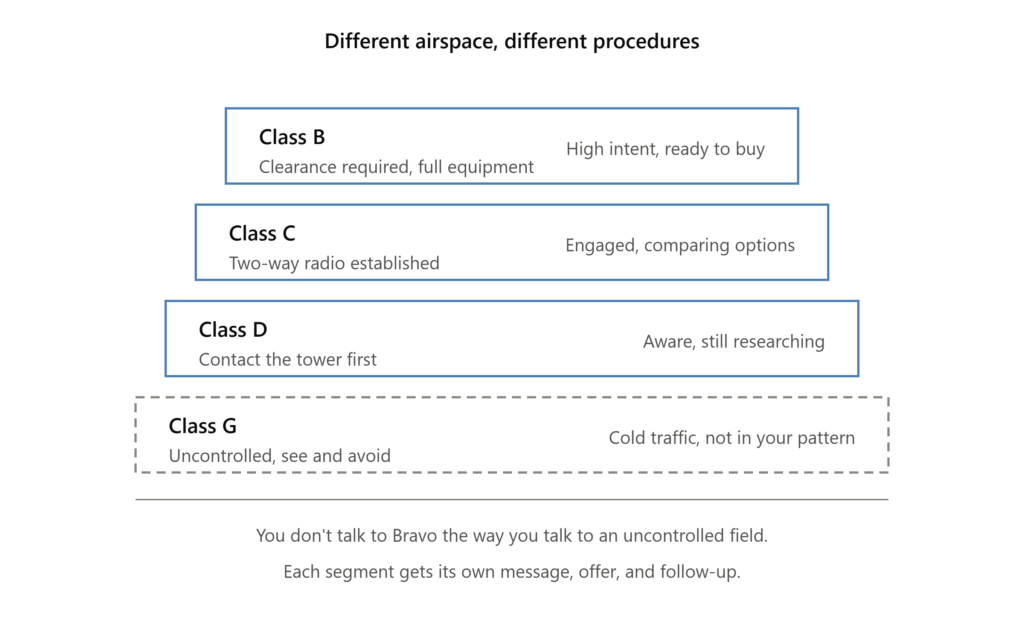
The sky isn’t one undifferentiated block. It’s Class B, C, D, E, and G, each with its own entry requirements, equipment demands, and radio procedures. You don’t talk to Bravo the way you talk to an uncontrolled field.
Your prospects work the same way. Segmentation means sorting them by who they are, what they fly, and what they actually need, then talking to each group on its own frequency.
Flight school segments
- Aspiring pilots with no hours yet
- Mid-training students
- Ready-for-checkride candidates
- Rusty pilots returning after years away
Maintenance shop segments
- Piston single owners
- Light twin owners
- Flying clubs
- Commercial operators needing fast turnarounds
Charter operator segments
- Business travelers
- Aircraft owners needing supplemental lift
- Sports teams and group charters
- Families prioritizing safety and convenience
Avionics shop segments
- Garmin-curious owners
- Operators needing ADS-B upgrades
- Part 135 operators needing compliance packages
Once each group is labeled, you can tailor your ads, emails, website content, lead magnets, and follow-up sequences to match.
Suddenly your marketing stops sounding like a billboard and starts sounding like ATC: clear, relevant, and confidence-building. That’s how you start attracting aviation leads that actually match your mission profile.
2. Refine Your Ad Copy So the Right Leads Self-Select
When ATIS is clear, concise, and relevant, you can picture the entire airport environment before you begin your descent.
Your copy should do the same thing. Speak to a specific person’s mission, frustrations, and constraints instead of announcing that you’re the best.
Instead of: “We offer the highest-quality charter solutions.”
Try: “Need a Part 135 aircraft with a two-hour launch window and a crew that never blows duty-time limits? We fly your schedule, not the other way around.”
Instead of: “Affordable flight training for everyone.”
Try: “Private pilot training built for working adults. Predictable scheduling, structured curriculum, and no surprise cancellations.”
Instead of: “Fast, dependable avionics work.”
Try: “G1000 installs without AOG purgatory. Firm timelines, transparent pricing, no guessing.”
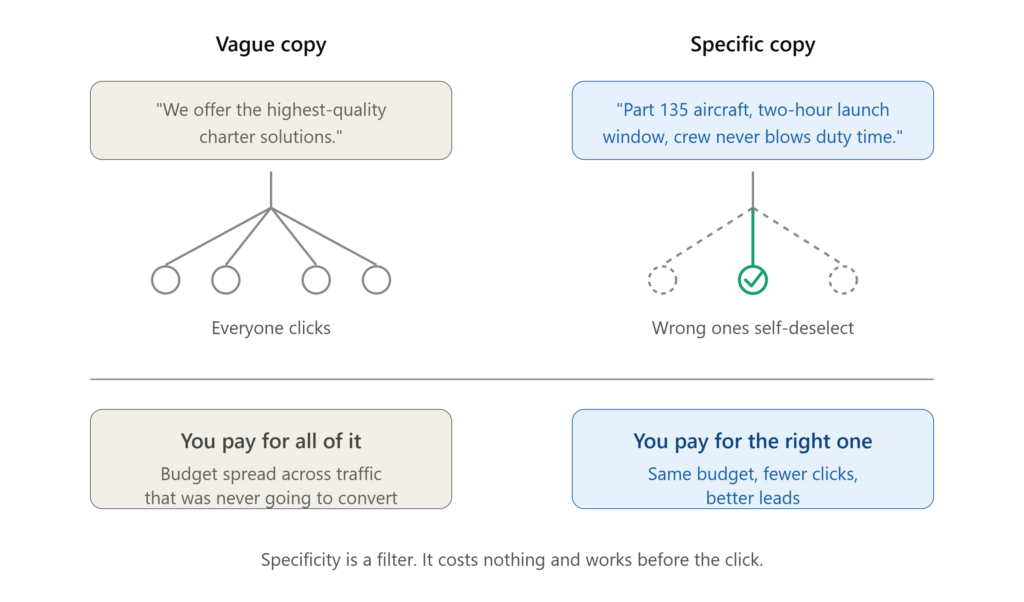
The pattern is the same every time: specific over general, benefit over feature, mission over ego.
When your message sounds like a pilot talking, the right leads identify themselves immediately. The wrong ones self-deselect, which means you stop paying for clicks that were never going to become quality aviation leads.
3. Build Intelligent Retargeting: Your Digital ADS-B In
Retargeting should work like traffic on your ADS-B display. You don’t chase every blip. You watch the ones on a converging course.
That means following behavior, not just impressions. Someone who read one page gets a different follow-up than someone who watched a full video and downloaded a guide.
- Visited your turbine maintenance page? Show ads about borescope inspections, hot-section turnarounds, or PT6 maintenance bundles.
- Watched a video on accelerated flight training? Retarget with financing options, schedule guarantees, or housing availability.
- Read your jet membership versus charter comparison? Retarget with a cost-per-seat-mile calculator for their mission profile.
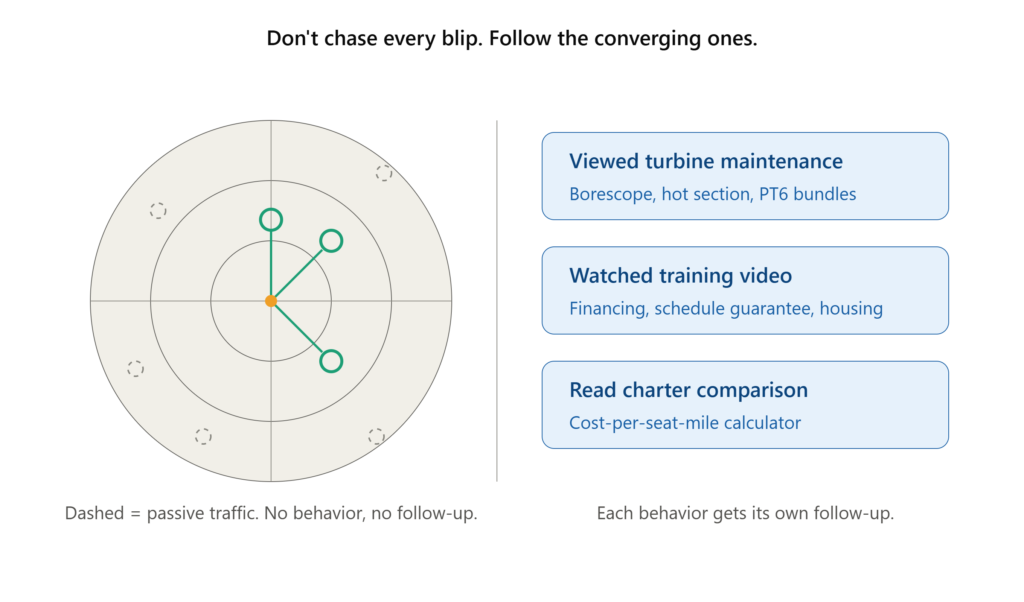
Retargeting isn’t nagging. It’s sequencing. Just like checklists. Just like flows. Just like flying.
Done right, it feels like the natural continuation of a conversation the prospect already started.
Your Budget-Neutral Lead Upgrade Plan
Segment your audience like you segment airspace
Define three to six personas and build a dedicated message path for each.
Rewrite your copy in pilot-native language
Clarity over clever. Mission over ego. Results over features.
Launch behavior-based retargeting sequences
Treat every click as a breadcrumb and follow the trail.
Reuse content across channels
Funnel emails become blog posts, blog posts become social content, social content becomes lead magnets, lead magnets feed retargeting flows.
Offer micro-commitments instead of big ones
A free safety briefing video, an aircraft ownership cost worksheet, an ADS-B mandate checklist, or a charter cost calculator will out-convert “contact us for a quote” every time.
Final Approach: You Don’t Need More Budget, You Need Better Targeting
Aviation is unforgiving of sloppiness. So is marketing.
Higher-quality aviation leads don’t come from working harder. They come from working like a pilot: segment with intention, communicate clearly, react to real behavior, follow the data like you follow instruments, course-correct as needed, and stay ahead of the aircraft.
Do that, and the right leads show up like a stabilized approach. Predictable. Consistent. On profile.
Want Help Dialing In Your Targeting?
At Aviation Lead Generation, this is the work: segmentation, copy, and retargeting built specifically for flight schools, Part 135 operators, MRO shops, and FBOs. If your current campaigns are burning budget on the wrong traffic, we’ll show you where it’s going.