

If “marketing” sounds like a foreign ATC frequency, this is your translation into pilot-speak. Clear, practical, and made for the cockpit mindset.
Table of Contents
What Is Aviation Marketing, Really?
In pilot terms, aviation marketing is your flight plan for customers.
It’s how you:
- File your route (your brand message)
- Choose your altitude (your target audience)
- Navigate to your destination (more bookings, students, or passengers)
Just like flight planning, marketing isn’t guesswork. It’s preparation, awareness, and understanding the winds aloft (market trends) before you take off.
The Four Fundamentals of Marketing (Explained Like a Pilot)
In marketing, they call them the Four Ps. In aviation, they’re your pre-flight checklist for business lift-off.
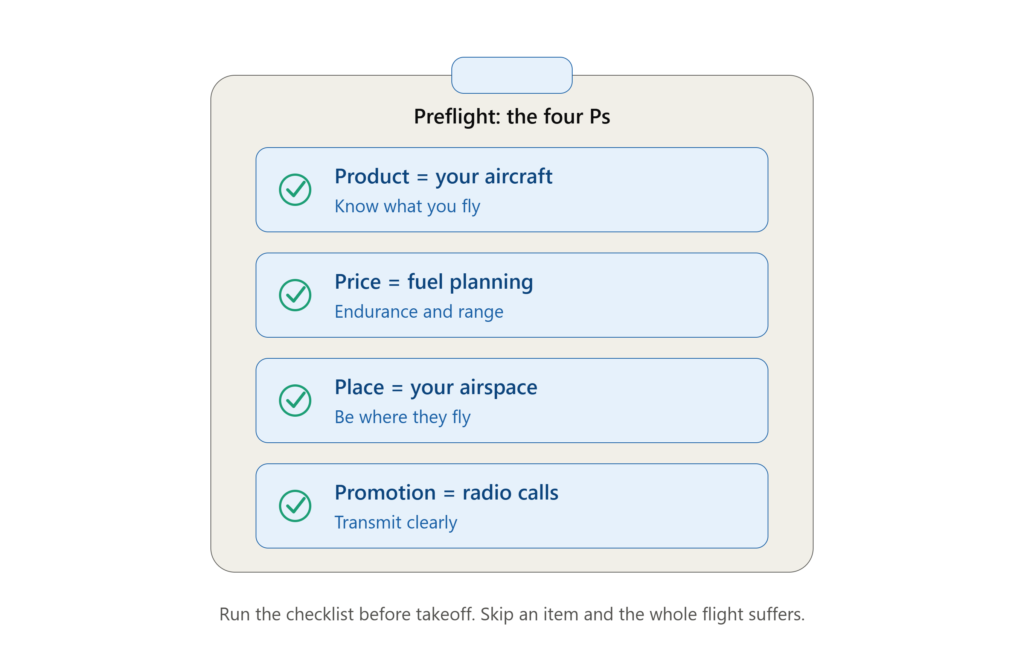
1. Product = Your Aircraft
Your aircraft defines your mission. Marketing works the same way.
Your product, whether it’s flight training, maintenance, charter, or avionics, is your aircraft. You can’t sell a Cessna as a Gulfstream.
Ask yourself:
- What am I really offering?
- What problem does it solve?
- What makes it airworthy in a crowded sky?
The clearer your answers, the stronger your lift.
2. Price = Your Fuel Planning
Set your price like you plan fuel: it’s about endurance and range.
Price too low, and you may not have enough to make it home. Price too high without clear value, and customers divert elsewhere.
In aviation marketing, price tells a story, not just of cost, but of confidence. It signals your level of performance and professionalism: “Here’s the quality you can expect when you fly with us.”
3. Place = Your Airspace
Where can people find you? That’s your place: your hangar, your website, your search results, your partnerships. In other words, your airspace.
Are you visible where your ideal passengers or clients are flying? Marketing is about being in the right sector when your customers are tuned in.
Pro tip: Treat your website like a well-marked runway. Clear, smooth, and easy to land on.
4. Promotion = Your Radio Calls
Promotion is communication. You can’t expect anyone to find you if you’re silent on the radio.
Your “promotion” is how you talk to the world:
- Website copy = your ATIS
- Social media = your CTAF
- Search ads = your transponder, broadcasting your position at the exact moment someone is looking for you
- Airshows and events = your frequency changes
It’s not about shouting. It’s about transmitting clearly and consistently.
Why Pilots Struggle With Marketing
Because marketing feels like flying without instruments.
Most pilots think in checklists, procedures, and measurable performance. Marketing feels ambiguous, like trying to hold altitude in turbulence.
But here’s the truth: good marketing is situational awareness. It’s reading the environment, anticipating what’s next, and adjusting before you stall.
When you frame it that way, marketing becomes a skill, not a mystery.
The Traffic Pattern of Aviation Marketing
Think of marketing as a standard traffic pattern:
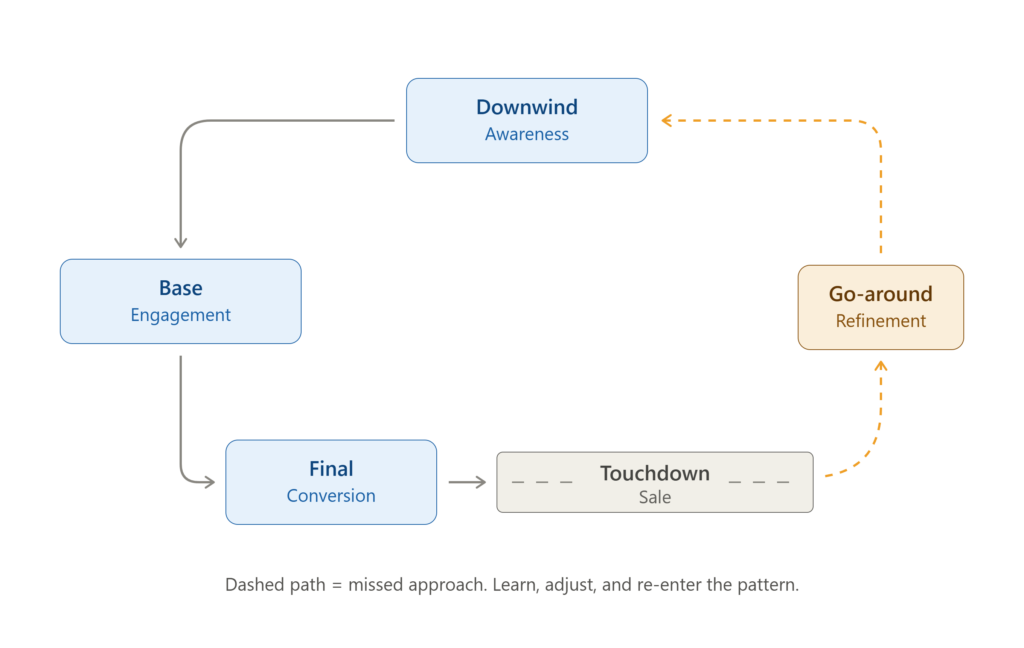
| Leg | Marketing Phase | Objective |
| Downwind | Awareness | Customers first notice you |
| Base | Engagement | They start turning toward you |
| Final | Conversion | They’re aligned and ready to buy |
| Touchdown | Sale | Smooth landing, deal closed |
| Go-Around | Refinement | Missed approach? Learn, adjust, and try again |
Every circuit builds proficiency. The more patterns you fly, the smoother your landings, and your marketing conversions.
How to Log Marketing Time (Without Burning Fuel)
You don’t need a giant ad budget to fly more hours on the marketing clock. Start simple and build muscle memory.
- Log weekly marketing hours. Update a post, call a prospect, request a testimonial.
- Track performance like a flight log. Where did inquiries come from? How many converted?
- Treat your marketing plan like a POH. Know your numbers, limitations, and checklists.
Consistency earns altitude.
Understanding Marketing Instruments (The Key Metrics)
Every pilot needs instruments. In marketing, your gauges are:
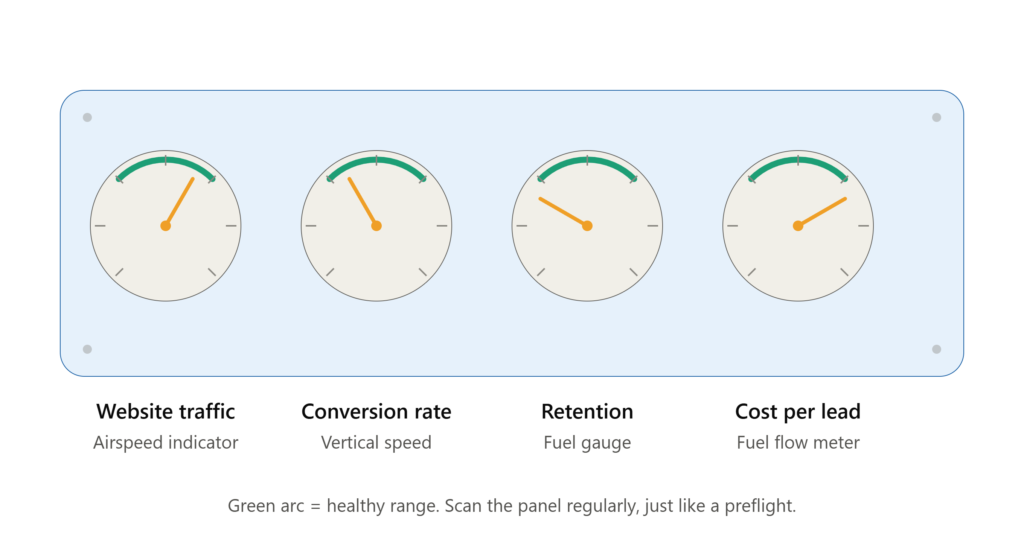
| Instrument | What It Shows | Pilot Equivalent |
| Website Traffic | How many people enter your airspace | Airspeed indicator |
| Conversion Rate | How many complete the mission (buy, book, call) | VSI, shows your climb rate |
| Customer Retention | How many keep flying with you | Fuel gauge for long-range endurance |
| Cost per Lead | How efficient your engines are | Fuel flow meter |
Just as you scan your panel, scan these metrics regularly. They’ll warn you before you enter dangerous territory.
Cost per lead deserves a longer look. It’s the clearest readout of whether your marketing engine is running efficiently, and it’s the number that paid channels like Google Ads live and die by. If you’re spending money to attract customers and can’t state your cost per lead, you’re flying without a fuel flow meter.
The Human Factors of Aviation Marketing
Human error causes accidents, and it can sink marketing efforts too.
Common “pilot errors” in marketing:
- Flying by gut instead of instruments (no data tracking)
- Ignoring weather briefings (no market research)
- Overconfidence in one channel (putting all thrust in one engine)
That last one deserves a note. Word-of-mouth is a great engine, but it’s one engine. Pair it with a channel you control, like paid search, so one slow referral month doesn’t put you into an unplanned descent.
Avoid these by running regular pre-marketing briefings: What’s our goal? What’s the weather (market) doing? What’s our contingency plan?
The Final Approach: Marketing With Integrity
Just as safety is aviation’s universal language, trust is marketing’s.
People don’t buy a flight. They buy confidence in the pilot. Your marketing should feel like a pre-flight briefing: clear, honest, and reassuring.
Avoid “turbulent” claims or clickbait. Speak plainly about performance and experience. If your messaging feels like you’re bragging instead of briefing, pull the power back.
When done right, aviation marketing doesn’t feel like selling. It feels like inviting others to share the freedom of flight.
Marketing Is Your Flight Plan for Growth
Aviation marketing isn’t manipulation. It’s communication. It ensures your business is seen, understood, and trusted long before the customer steps onto your ramp.
Every good pilot knows that the only thing more dangerous than bad weather is taking off without a flight plan. Marketing is that plan, and when you follow it, altitude and opportunity come naturally.
Ready to Put a Flight Plan Behind Your Leads?
This is what we do at Aviation Lead Generation. We build and fly Google Ads campaigns for flight schools, Part 135 operators, MRO shops, and FBOs, run by people who speak both PPC and pattern work. If you want a lead system with instruments you can actually read, reach out and we’ll walk you through how it works.